
What Is UI/UX Design?
- Razu Ahmed
- UI/UX
- Reading Time: 6 minutes

Most founders build something that works. The harder truth is that 88% of users won’t return after one bad experience, not because the product failed technically, but because it felt confusing or slow. That number comes from a widely cited Sweor study on web design statistics. Getting design right from day one is not a luxury; it’s the difference between a product people choose to return to and one they quietly delete.
Whether you’re raising a seed round, shipping an MVP, or scaling toward Series A, the design layer of your product is not decoration. It’s infrastructure. Every screen your user touches is a moment of truth: stay, engage, convert, or leave. The Interaction Design Foundation reports that companies investing seriously in UX see a return of up to $100 for every $1 spent. Getting that layer wrong costs more than a redesign; it costs trust, retention, and revenue.
UI vs. UX: What's the Actual Difference?
People use the terms interchangeably. They’re not the same thing.
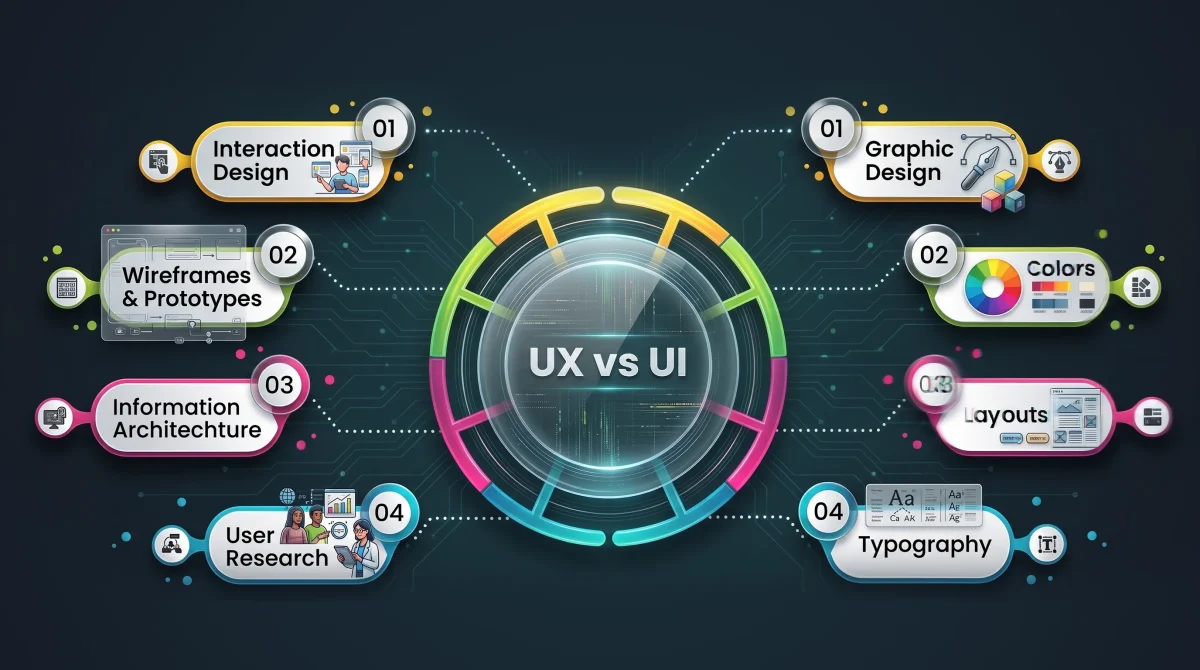
UI Design focuses on:
- The visual hierarchy of every page.
- Color systems and typography choices.
- Button states, icon design, and interactive elements.
- Consistency across screens and devices.
UX Design focuses on:
- The user journey from first click to task completion.
- Research: what do users actually need?
- Information architecture, like where does everything live?
- Testing and iteration based on real user behavior.
Think of it this way: UI is the face. UX is the brain behind it. A beautiful interface with a broken flow frustrates users just as much as an ugly one with a smooth flow confuses them. Both disciplines live inside every great product you’ve ever loved, and both need to be done well.
How UI/UX Design Affects Your Business (The Numbers Don't Lie)
UI/UX design is not just a creative discipline. It shows up directly in your revenue. Forrester Research found that a well-designed user experience can raise conversion rates by up to 400%. Baymard Institute puts the average cart abandonment rate at 70.19%, a number driven largely by poor checkout UX. Meanwhile, McKinsey data shows that design-led companies outperformed the industry benchmark by 2:1 over five years.
The table below shows what changes when design is taken seriously.
|
Business Metric
|
Without Strong UI/UX
|
With Strong UI/UX
|
|---|---|---|
|
User retention (first session)
|
~12% return
|
70%+ return
|
|
Conversion rate (e-commerce)
|
1–2% average
|
3–5%+ with strong UX
|
|
Support ticket volume
|
Highly confused users
|
Significantly lower
|
|
Cost to fix design flaws
|
10× higher in dev phase
|
Caught early, cheap to fix
|
|
Investor reads on product execution
|
Skeptical
|
Confident in the team
|
|
Time on core task completion
|
Long, frustrating
|
Fast, intuitive
|
Sources: Forrester Research, Baymard Institute, McKinsey & Company, Dotmarq.
The UX Design Process: How a Good Agency Actually Works
- Discovery: Who are your users? What tasks are they trying to complete? User interviews and competitive audits happen here.
- Information architecture: Deciding what goes where and why. This is the sitemap and user flow stage.
- Wireframing: Low-fidelity layouts that test structure without visual style getting in the way.
- Prototyping: Clickable mockups built for user testing and stakeholder review.
- Visual design: Color, typography, iconography, and component design applied to the validated structure.
- Handoff: Developer-ready files, design systems, and full spec documentation.
What Startup Founders Get Wrong About UI/UX Design
The most common mistake: treating design as the last step.
Design decisions made in week 12 of a build are the most expensive to change. When the navigation structure is wrong, you don’t fix a screen; you rethink flows, update components, and re-test across devices. The cost of fixing a UX problem during development is 10× higher than catching it in the design phase.
The second mistake: hiring for aesthetics over function. A beautiful app that confuses users is a liability. Design must solve a problem first. If your screens look great but users can’t find the checkout button, you’ve built a very expensive obstacle. See how design services built for startups actually approach this from the ground up.
The third: no user research. A 5-person usability test before launch can surface problems that would otherwise take months of customer support tickets to find. If you’re building without talking to your users first, you’re guessing. Explore Dotmarq’s full design process.
What to Look for When Hiring a UI/UX Design Partner
Not every agency treats design as a discipline. Some treat it as a deliverable, a set of screens dropped in your inbox with no context for why.
A real UI/UX partner looks like this:
- They ask about your users before they ask about your brand guidelines.
- They showcase studies with measurable outcomes, not just pretty screenshots.
- They work across the full stack: research, wireframes, visual design, and developer handoff.
- They build reusable design systems, not one-off screens.
- They understand your business model well enough to design for conversion, not just aesthetics.
A strong design partner reduces your time-to-market, lowers rework costs, and gives you a product people actually recommend. At dotmarq, the team covers everything from UX research to pixel-perfect UI delivery, working closely with development so nothing gets lost in translation.
The Bottom Line
UI/UX design is not about making things look nice. It’s about making things work — for real users, under real conditions, with real business goals tied to every screen.
A well-designed product retains users, reduces support costs, and converts more visitors into customers. A poorly designed one does the opposite, quietly, one frustrated user at a time.
If you’re a founder or startup team ready to take your product’s design seriously, the next step is working with a team that understands both the craft and the business behind it.
DOTMARQ helps startup founders and growth-stage teams build products users actually want to use, from UX research and wireframing to full UI design and digital product delivery.
Get in touch and let’s build something people return to →
DOTMARQ makes your document production consistent, on-brand, and deadline-ready without the back-and-forth.

- Razu Ahmed
- 6 minutes
What Is UI/UX Design?
Related posts